Welcome: Guangzhou DIGE Textile Co., Ltd
Language:
 ∷

∷
 ∷
For many years, hotel bedding has been evaluated using a familiar set of words:
soft, clean, fluffy and comfortable.
For pillows and duvets, buyers often focused mainly on filling weight, loft, warmth and firmness.
But in 2026, material innovation is bringing a new direction to hospitality bedding.
More fiber and textile technology companies are introducing functions such as:
cooling, moisture management, allergen control, freshness, quick drying, loft retention and sustainability
into products designed for home and hospitality use.
Hotel bedding is gradually moving from providing basic comfort to delivering a more specialized and functional sleep experience.
In September 2026, Intrinsic Advanced Materials announced an expansion of CiCLO technology into home textile and hospitality applications, including collaborations with ADVANSA and HeiQ.
ADVANSA is integrating CiCLO technology into its Suprelle filling materials for bedding, home textile and hospitality applications.
The relevant product development directions include:
At the same time, collaboration with HeiQ extends into areas such as thermal comfort, allergen management, odor and freshness control, moisture management and quick-dry performance.
This reflects an important change in the bedding industry:
the question is no longer only “what is inside the pillow or duvet?”
It is increasingly becoming:
“what can the filling material actually do?”
A household product usually serves one person or one family.
Hotels are different.
A hotel room may host completely different guests from one night to the next.
Some guests sleep hot.
Some prefer warmth.
Some need more pillow support.
Others prefer softer or lower pillows.
Some are more sensitive to humidity, dust or allergens.
Hotels cannot realistically customize the entire sleep environment for every guest.
That is why the bedding itself can become an important tool for covering a wider range of sleep preferences.
For example:
moisture-managing and breathable duvets may be better suited to warm climates or heavily air-conditioned rooms;
supportive pillows may suit business hotels where neck and shoulder comfort is especially important;
lightweight high-loft fillings can create a fuller visual appearance while still maintaining comfort;
and cooling or temperature-regulating materials may help resort and upscale hotels build a more distinctive sleep experience.

This development also matches the hospitality industry’s growing focus on sleep quality.
In the past, many hotel rooms offered a very simple pillow setup:
two soft pillows or two standard pillows.
Today, more upscale hotels offer multiple pillow options, such as:
soft pillows, firm pillows, down pillows, fiber pillows and supportive pillows.
The logic is straightforward.
A mattress is difficult to change for each guest.
A pillow is much easier to adjust.
This makes pillows one of the most practical ways for hotels to personalize sleep comfort.
As filling technologies continue to evolve, pillow menus may eventually move beyond:
soft vs. firm
toward categories such as:
supportive, cooling, breathable, low-allergen and high-loft.
A similar shift is happening with hotel duvets.
Traditionally, buyers often begin with questions such as:
How many grams of filling?
Summer or winter weight?
Down or synthetic fiber?
These remain important.
However, future duvet selection may become more detailed.
Even at the same filling weight, different fiber structures can create different levels of:
loft, air retention, breathability, drape and resilience.
This means:
the same weight does not necessarily create the same sleep experience.
For hotel buyers, evaluating a duvet may increasingly require looking beyond fill weight to consider:
fiber structure, loft recovery, breathability and climate suitability.
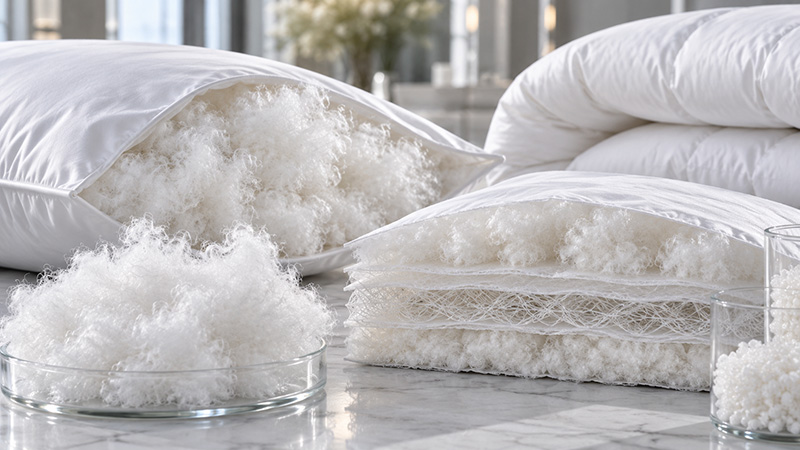
Another important development is that sustainable materials are moving into parts of hotel products that guests may never directly see.
The use of CiCLO technology in hospitality filling applications is one example.
The technology is designed for polyester and nylon fibers, with the aim of reducing the persistence of synthetic microfibers in certain end-of-life environments. Relevant performance claims are tested using ASTM and ISO methods.
At the same time, fiber manufacturers such as ADVANSA continue to expand recycled-material applications in bedding fillings.
This creates an interesting shift.
When consumers think about hotel sustainability, they often think first about:
reducing disposable amenities, saving water or saving energy.
In the future, another question may become relevant:
What is inside the pillow and duvet?
That means sustainability may increasingly become part of the hotel bedding material system itself.
However, more functions do not necessarily mean a product is better suited to hotels.
This is especially important in hospitality procurement.
Hotels also need to consider:
product stability, batch consistency, large-volume supply, guest acceptance and long-term performance.
A material may offer impressive technical features, but if its performance varies between batches or if supply cannot remain stable, it may create problems for a large hotel property.
For this reason, hotels do not necessarily need:
the bedding with the most functions.
They need:
the bedding whose functions best match the real operating environment.
Traditionally, hotel bedding was built around a simple product set:
bed sheet + duvet cover + pillowcase + pillow + duvet.
In the future, this system may become more specialized.
A pillow may be designed for different support needs.
A duvet may be selected according to climate and hotel positioning.
The same synthetic filling category may offer different cooling, moisture management, loft recovery or sustainability characteristics.
This means competition in hospitality bedding may no longer focus only on:
thread count, fabric weight or fill weight.
Another question is becoming increasingly important:
What different sleep experience can this product provide to hotel guests?
As a hospitality textile supplier, Guangzhou Dige Textile Co., Ltd. continues to pay close attention to the development of hotel pillows, duvets and bedding materials.
We believe product specifications remain an essential foundation for hotel procurement.
However, as guest expectations become more diverse, product development should also consider:
hotel positioning, guest profile, local climate, mattress configuration and real room-use conditions.
A good hotel pillow is not defined only by filling weight.
A good hotel duvet is not defined only by how fluffy it looks.
Ultimately, bedding has one important task:
to help guests achieve a comfortable and consistent sleep experience in an unfamiliar room.
From cooling and moisture management to advanced functional fibers, new materials are creating more possibilities for hotel bedding.
This is likely to remain an important area of development for the hospitality textile industry.
Contact: Tracy Kuang
Phone: +86-18565305509
Tel: 020-26261315
Email: 1702435072@qq.com
Add: No.38 Xihua Street, Maoshan, Jianggao Town, Baiyun District, Guangzhou, China