Welcome: Guangzhou DIGE Textile Co., Ltd
Language:
 ∷
∷

∷
 ∷
∷
Bed sheets, duvet covers, pillowcases, towels, bath towels and bathrobes are among the most common items found in any hotel.
Yet for hotel purchasing, housekeeping, warehouse and operations teams, linen can also be one of the most underestimated management challenges.
Buy too cheaply, and the products may not withstand repeated commercial washing.
Buy at a higher price, and purchasing costs become harder to control.
Keep too little inventory, and the hotel may run short during peak occupancy.
Keep too much, and capital and storage space are tied up.
Send 100 towels to the laundry — but how many actually come back?
Why do some bed sheets become harder after repeated washing?
Why do duvet covers gradually become smaller?
And when replenishment arrives six months later, why does the new batch sometimes feel different from the original one?
These are not minor operational details.
They directly affect hotel costs, housekeeping efficiency and guest experience.
The first challenge begins with purchasing.
Thread count, yarn count, fabric density, fabric weight, tensile strength, shrinkage and colorfastness can all appear on a hotel linen specification sheet.
But hotels are not really buying a specification sheet.
They are buying a product that needs to perform after repeated use and repeated washing.
A bed sheet may feel soft when new, but how will it feel after 30 or 50 commercial wash cycles?
A duvet cover may meet its original dimensional specifications, but will it maintain the correct size after repeated washing and drying?
This is why modern hotel linen procurement increasingly needs to consider long-term performance rather than only the appearance and hand feel of a new sample.
For hotel operators, the real question is:
How will this product perform throughout its service life?

Hotels want linen to be clean, bright and stain-free.
At the same time, they also expect sheets and towels to remain strong, soft and dimensionally stable for as long as possible.
This creates a difficult balance.
Water temperature, detergents, bleaching chemicals, drying conditions and washing cycles can all affect textile lifespan.
If the wash process is too mild, stains or whiteness may not meet hotel standards.
If it is too aggressive, fibers may weaken faster.
The result can be:
For hotels, professional linen care therefore involves balancing two goals:
cleanliness and service life.
A product that washes beautifully but deteriorates too quickly can still create a high operating cost.
One of the most common hotel linen challenges is loss.
A piece of linen may move through many locations during a single cycle:
guestroom → floor linen room → laundry collection → laundry facility → transport vehicle → hotel warehouse → guestroom
Every handover creates an opportunity for counting errors, sorting mistakes or missing items.
Traditional systems often rely heavily on manual counting.
When quantities do not match, it may be difficult to determine where the problem actually occurred.
One missing towel may not seem important.
But consider:
a few missing items per day × multiple linen categories × 365 days
The annual cost can quickly become significant.
This is one reason why hotels are paying increasing attention to clearer handover procedures, inventory reconciliation and digital linen tracking.
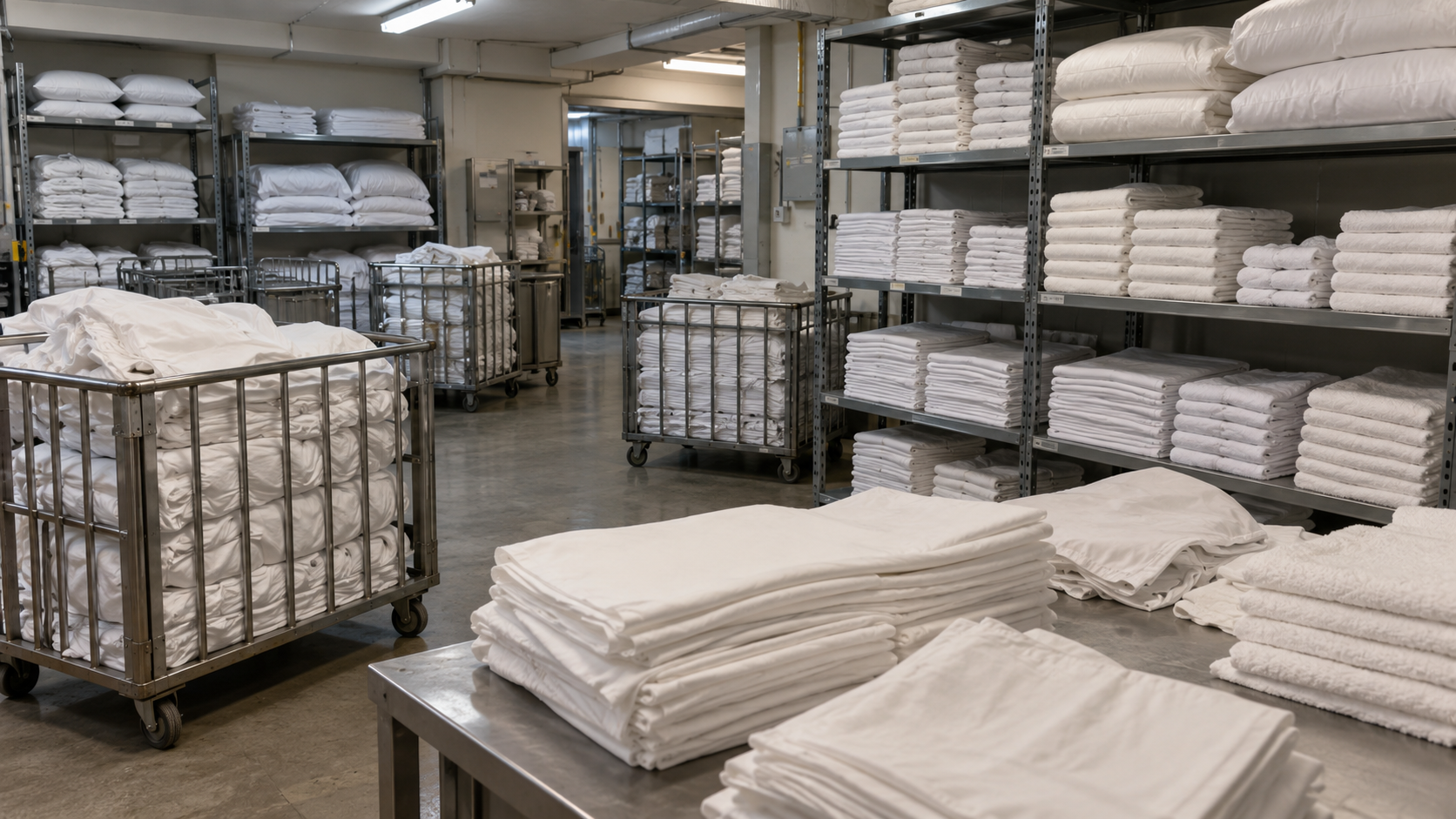
Another difficult question is:
How much linen should a hotel actually keep?
Too much inventory creates unnecessary purchasing cost and occupies valuable storage space.
Too little inventory creates operational risk.
A hotel can quickly run short when:
This is why hotels often use the concept of PAR level to manage linen inventory.
However, there is no single PAR level that is correct for every property.
The right amount depends on factors such as:
room count + occupancy + laundry cycle + transport time + rewash rate + linen loss + operational model
A hotel with an on-site laundry facility may need a different safety stock level from a property that sends its linen to an external commercial laundry.
The real objective is not to maximize inventory.
It is to achieve:
the lowest reasonable inventory level without creating supply risk.
Over time, hotel linen will naturally wear out.
But when damage appears, another question follows:
Was it normal wear, or was the linen damaged during washing?
This can be difficult to determine.
If a bed sheet develops a hole, the hotel may believe it was caused by laundry equipment.
The laundry provider may argue that the product was already near the end of its usable life.
The textile supplier may believe the wash process was too aggressive.
As a result, responsibility can become unclear between:
hotel → laundry provider → linen supplier
This is why increasingly detailed linen service agreements define:
Better lifecycle records can make responsibility easier to determine.
Without them, disputes become more difficult to resolve.
One of the most overlooked hotel linen challenges is batch consistency.
A supplier may deliver 1,000 bed sheets successfully for the initial order.
But six months later, the hotel may need another 200.
Will they match?
Hotels may notice differences in:
For home consumers, small differences between batches may not matter.
Hotels operate standardized guestrooms.
When linen in different rooms or on different floors looks or feels noticeably different, housekeeping and inventory management become more complicated.
This means hotel buyers increasingly need more than:
“Can you make this product?”
They also need to know:
“Can you continue making this product to a consistent standard?”
Long-term replenishment capability is becoming an important part of supplier evaluation.
The purchase price of linen is only one part of its real cost.
A more complete linen lifecycle includes:
purchase → storage → use → laundry → transport → loss → rewash → replenishment → replacement
Consider two products.
Product A has a lower purchase price but shrinks quickly and wears out faster.
Product B costs slightly more but maintains its dimensions and durability for longer.
If purchasing price is the only factor considered, Product A appears cheaper.
But if it needs to be replaced more frequently, its real cost per use may actually be higher.
This is why hotel linen procurement is gradually moving from asking:
“How much does one sheet cost?”
to asking:
“How long can one sheet perform reliably?”
When all of these challenges are viewed together, one thing becomes clear:
Hotel linen is not simply a consumable product.
It connects:
purchasing, housekeeping, warehousing, laundry, external service providers, suppliers and ultimately the guest.
A problem in any part of that chain can eventually become either:
higher operating cost or lower guest satisfaction.
This is also why technologies such as RFID tracking, digital inventory systems, wash-cycle recording, batch management and supplier performance monitoring are receiving more attention.
More mature linen management should not wait until:
stock runs out, products are damaged or complaints occur.
Instead, it should gradually move toward:
planned procurement + process control + inventory visibility + lifecycle management
As a hospitality textile supplier, Guangzhou Dige Textile Co., Ltd. continues to focus on the real operating performance of bed sheets, duvet covers, pillowcases, pillows, duvets, towels and other hotel textile products.
We believe many hotel linen problems do not begin in the laundry room.
They can often be reduced much earlier, during product selection and manufacturing.
Before production, hotels and suppliers should consider:
hotel positioning, bed dimensions, laundry method, washing frequency, shrinkage control, fabric strength and future replenishment needs.
For hotel operators, suitable linen should not only look clean and comfortable when it is first placed on the bed.
What matters more is whether it can continue to perform consistently after repeated use and repeated washing.
Procurement, laundry, inventory, loss and replenishment may appear to be separate problems.
In reality, they all point toward the same goal:
helping hotels maintain consistent linen quality at a more controllable total operating cost.
That may be one of the most important challenges facing the hotel linen industry today.

Contact: Tracy Kuang
Phone: +86-18565305509
Tel: +86-18565305509
Email: 1702435072@qq.com
Add: No.38 Xihua Street, Maoshan, Jianggao Town, Baiyun District, Guangzhou, China