Welcome: Guangzhou DIGE Textile Co., Ltd
Language:
 ∷

∷
 ∷
For decades, hotel guestrooms have largely been designed around a familiar assumption:
two people will stay in the room.
A king bed or two twin beds, several pillows, standard bedside furniture and a room layout built for one or two guests.
But that assumption may be becoming less reliable.
According to Hilton’s 2027 Trends Report, 41% of surveyed travelers say they plan to take a solo trip within the next year.
Among those planning to travel solo, 92% have already done so before.
More importantly, today’s solo traveler is not necessarily someone who spends the entire journey alone.
Hilton describes this emerging behavior as:
It refers to travelers who may leave home alone, meet friends or family at the destination, spend part of the trip independently, or add personal travel time before or after a business or group trip.
For the hotel industry, this is more than a change in who books the room.
It may also change how guestrooms are designed, equipped and experienced.
Traditional solo travel is easy to define:
one person departs alone, travels alone and returns home alone.
But modern travel patterns are becoming more fluid.
A traveler might arrive two days before friends.
A business traveler may extend a work trip for a personal weekend.
Someone may join a group itinerary but choose to stay in a separate hotel room.
Another guest may spend the day socializing and still prefer to return to a completely private room at night.
Hilton’s research found that 31% of travelers had traveled alone to a destination in the previous year and then met people they already knew once they arrived.
This suggests an important shift:
They may simply want greater control over their own time and private space.
For many travelers, solo trips are connected to rest, flexibility and personal space.
Among people planning to travel alone, Hilton’s research identified motivations including:
relaxation and recharging, personal reflection, flexible scheduling and the freedom to make decisions without compromising with others.
That matters to hotels.
When someone travels alone, the guestroom may play a more important role in the overall journey.
There is no travel companion sharing attention or shaping the room experience.
Guests may notice more clearly:
Is the room quiet?
Is the bed comfortable?
Does the pillow suit my sleeping position?
Is the lighting relaxing?
Is there somewhere comfortable to read, work or simply do nothing?
For solo guests:
One obvious response to growing solo travel would be to make hotel rooms smaller.
But that may be too simple.
Compact guestrooms can certainly improve space efficiency, especially in major cities.
However, solo travelers often value both privacy and opportunities for social interaction.
This is why some newer hotel concepts combine:
efficient private guestrooms with larger, more flexible public spaces.
A guest can return to a quiet room when they want privacy, then move to a lobby, café, lounge or shared workspace when they want interaction.
The future solo-friendly hotel may therefore not simply reduce the size of the room.
Instead, it may rethink the balance between:
private space and social space.
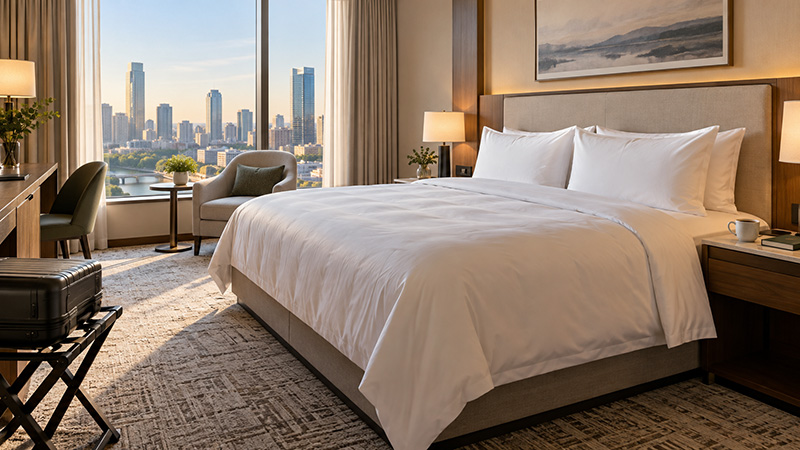
Furniture can become more compact.
Wardrobes can become open hanging areas.
Desks can become multifunctional surfaces.
But there is one part of most guestrooms where reducing the experience is much more difficult:
For a solo guest, a large hotel bed may actually become the largest private space in the room.
After a day of travel, the bed may be used for much more than sleeping.
Guests may:
watch a movie,
use their phone,
read,
work on a laptop,
relax,
or simply enjoy being alone.
That means the bed effectively becomes:
a sleeping area, relaxation area and personal space at the same time.
As guestrooms become more efficient, comfort in the bed area may become even more important.
This puts greater attention on:
bed sheets, pillows, duvets, mattress comfort and the overall sleep environment.
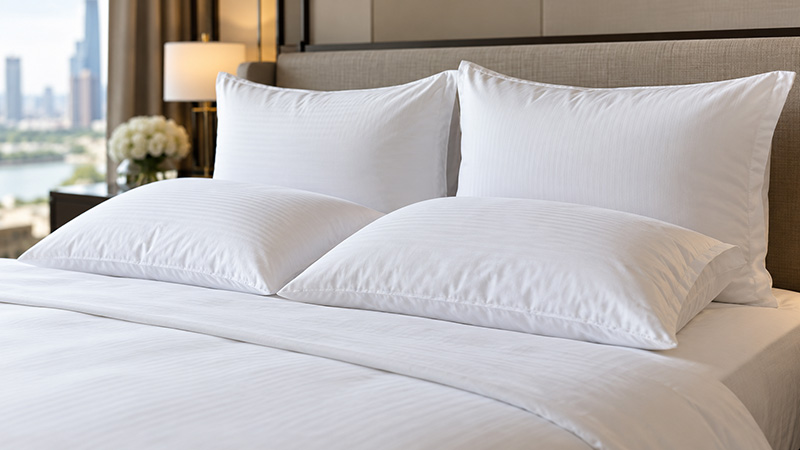
There is another interesting detail.
Many hotel king rooms traditionally display four pillows.
Visually, it creates a full and luxurious bed.
But when only one guest is staying in the room, those four pillows can serve a more useful purpose.
Instead of being four nearly identical pillows, hotels could consider combinations such as:
two softer pillows and two more supportive pillows.
Or different heights.
Or different filling structures.
The same four pillows then move from being purely visual decoration to becoming:
For a solo traveler, this can be particularly useful.
The guest does not need to divide pillow options with another person and can arrange the bed entirely around personal sleeping preferences.
This reflects a broader change in hotel bedding:
from standard room configuration toward experience-based configuration.
Another theme highlighted in Hilton’s 2027 travel outlook is a growing interest in shorter and more frequent trips.
Not every journey needs to be a long vacation.
A traveler may take:
a one-night weekend stay,
a two-day city break,
an extra personal night after a business trip,
or a spontaneous short trip to a nearby destination.
These trips are easier to organize and can often be decided at relatively short notice.
For hotels, however, shorter stays create an interesting challenge.
There is no second night for the guest to become accustomed to an uncomfortable pillow.
There is no third day to compensate for a poor first impression.
A comfortable bed, supportive pillow and pleasant room environment can therefore create a strong memory even during a very short stay.
Hilton describes its broader 2027 travel theme as “The Great Rebalance.”
The idea reflects a shift toward travelers designing trips around their own rhythms and priorities.
Less pressure to follow a fixed checklist.
More flexibility.
More personal time.
More room for rest.
As travel becomes more individualized, hotels may offer increasingly flexible spaces, digital services and personalized options.
But the more complicated travel behavior becomes, the more valuable a few basic things remain:
a clean room, a quiet environment, a comfortable bed, the right pillow and a good night’s sleep.
Travel behavior may change rapidly.
The need to rest well probably will not.
As a hospitality textile supplier, Guangzhou Dige Textile Co., Ltd. continues to follow changes in travel behavior and guestroom experience.
Our hotel textile products include bed sheets, duvet covers, pillowcases, pillows, duvets and other guestroom bedding products.
We believe the future of hotel bedding may be increasingly difficult to define through one universal configuration.
Standardization will remain essential for hotel operations.
But within a standardized system, hotels can introduce greater flexibility through:
different pillow heights, different support levels, climate-appropriate duvets and more thoughtful bedding combinations.
The fact that 41% of surveyed travelers plan to travel solo does not mean hotels need to create a completely separate product category for them.
Instead, it sends a broader message:
A well-designed guestroom should also give them more freedom to rest in their own way.
Hotels may become smarter.
Rooms may become more flexible.
Travel may become more personalized.
But at the end of the day, the guest still returns to the same place:
the bed.
And however travel changes, sleeping well is unlikely to go out of style.
Source Note: This article is an original hospitality-industry analysis inspired by Hilton’s 2027 Trends Report and its research on “Solo-ish” travel, short-trip behavior and changing traveler priorities.
Contact: Tracy Kuang
Phone: +86-18565305509
Tel: 020-26261315
Email: 1702435072@qq.com
Add: No.38 Xihua Street, Maoshan, Jianggao Town, Baiyun District, Guangzhou, China