Welcome: Guangzhou DIGE Textile Co., Ltd
Language:
 ∷

∷
 ∷
When a family or a group of friends travels together, choosing hotel accommodation can present a familiar challenge.
Should four, five or six people book separate hotel rooms, or should they stay together?
Traditional hotel guestrooms are generally designed around one or two occupants.
A king-size bed or two twin beds, accompanied by standard sheets, duvet covers, pillows and other guestroom amenities, is a familiar arrangement across the hospitality industry.
However, this traditional configuration does not always meet the needs of multigenerational families, parents traveling with children or groups of friends.
These travelers may want to stay together, share meals and spend time in a common living area while maintaining sufficient privacy for sleeping and personal activities.
In October 2026, a newly opened apartment hotel in Osaka, Japan, introduced a guestroom concept designed specifically around these needs.
The project provides an interesting example of how changing travel patterns may influence hotel room layouts, bedding configurations and hospitality textile requirements.
On October 1, 2026, MIMARU officially opened MIMARU Osaka Namba Station Annex, a new apartment-style hotel in Osaka's Namba district.
Operated by Cosmos Hotel Management Co., Ltd., the property features 68 guestrooms.
Approximately half of these rooms are designed to accommodate up to six adult guests, while the other half primarily cater to groups of four adults.
Unlike conventional business hotels, MIMARU focuses on families and groups traveling together.
Every guestroom includes a kitchen, dining area and in-room washer-dryer, allowing guests to enjoy a more residential style of accommodation.
One of the property's most distinctive room types is the Sky Garden Three-Bedroom Suite.
Located on the top floor, this 100-square-meter suite features three bedrooms, six single beds and a private outdoor terrace.
It also includes three washbasins, two toilets, a bathroom and a separate shower room.
These facilities are designed to make shared accommodation more convenient for larger families and multigenerational groups.
The concept addresses a practical question:
How can six people stay together without having to share every moment in the same space?
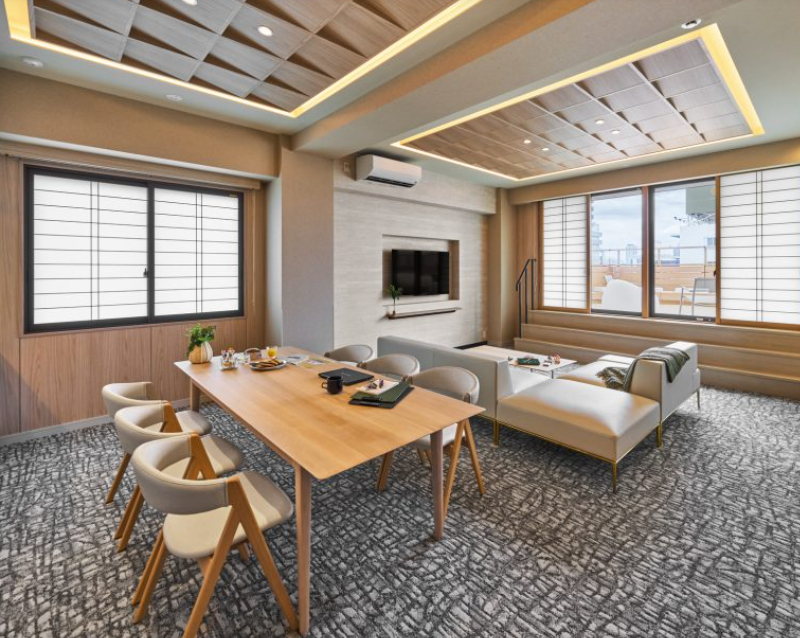
For decades, the most common hotel room categories have been king rooms and twin rooms.
These configurations work well for business travelers, couples and many individual guests.
However, larger travel groups have more complex requirements.
A family of four may need multiple sleeping spaces.
A family traveling with grandparents may prefer separate bedrooms within the same accommodation unit.
Six friends traveling together may want shared living areas while maintaining individual sleeping arrangements.
Traditionally, hotels have often addressed these requirements by offering multiple guestrooms or connecting rooms.
Apartment-style hotels provide another approach.
Instead of dividing one group across several rooms, they create a larger accommodation unit that supports shared living.
MIMARU Osaka Namba Station Annex offers a variety of room configurations, including two-bedroom apartments, bunk-bed rooms and larger family apartments.
These different layouts allow guests to select accommodation according to group size, sleeping preferences and the relationship between travelers.
This reflects a broader change in guestroom planning.
Hotels are not only asking how many guests can fit into a room.
They are increasingly considering how those guests will actually use the space together.
From a hospitality textile perspective, multi-person accommodation introduces new considerations.
A conventional double-occupancy guestroom usually has a relatively simple bedding configuration.
However, an apartment designed for four to six guests may contain several different bed types.
Depending on the layout, these could include single beds, double beds, bunk beds or loft-style beds.
Each bed type requires appropriately sized bedding.
Bed sheets must fit the mattress dimensions.
Duvet covers need to correspond with the selected duvet size.
Pillows and pillowcases should be suitable for the individual sleeping positions and room configuration.
Furthermore, when a single apartment contains multiple sleeping areas, bedding should provide a consistent level of quality while fitting the overall interior design.
For hotel buyers, the challenge is therefore not simply:
"We used to need two bedding sets, and now we need six."
The more important question is:
"How should the bedding system be configured according to the bed types, room layout and actual guest requirements?"
This distinction becomes increasingly important as accommodation products become more specialized.
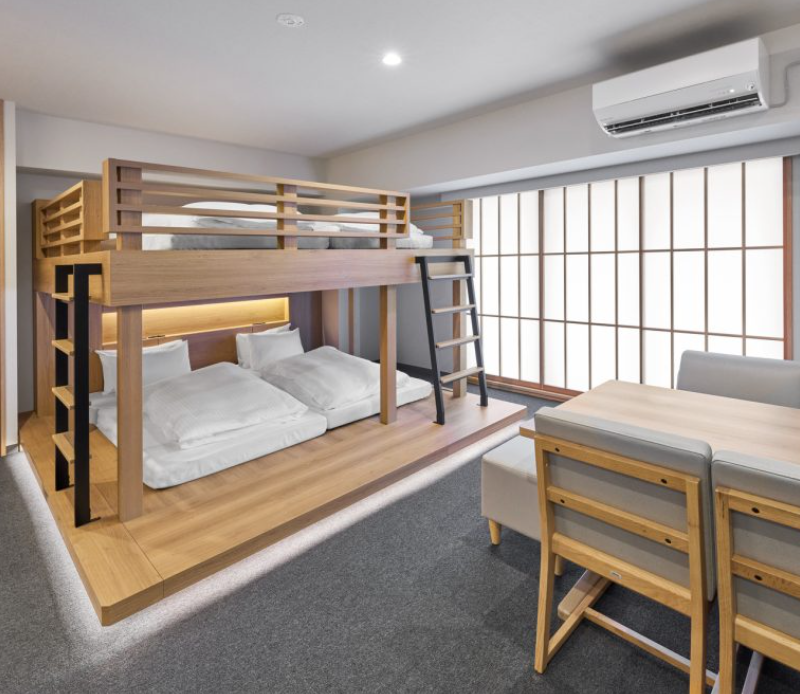
Another notable feature of the newly opened MIMARU property is the use of bunk beds and loft-style sleeping arrangements in selected guestrooms.
While bunk beds are less common in traditional upscale hotel guestrooms, they have practical applications in family hotels, hostels and apartment-style accommodation.
They allow properties to provide additional sleeping capacity without using as much floor space as separate beds.
However, these configurations also introduce specific considerations for bedding selection.
Bed sheets must accurately match mattress dimensions.
Duvets should provide suitable comfort without creating unnecessary bulk in a limited sleeping area.
Pillow height and filling structure should be considered in relation to the available space and the intended users.
Where bunk beds are used by children, hotels must also pay close attention to appropriate bed structures, guardrails, age restrictions and applicable safety requirements.
These details demonstrate that:
Hotel bedding selection involves more than fabric type and filling weight. It also requires an understanding of the physical environment in which the products will be used.
For hospitality textile suppliers, the ability to work with different bed dimensions and room configurations may become increasingly valuable.
Family travel differs from conventional business travel in another important way.
Several generations may share the same accommodation unit.
A typical group might include grandparents, parents and children.
These guests may have different preferences regarding pillow height, support, duvet weight and fabric texture.
This does not mean hotels must provide completely customized bedding for every individual.
However, family-oriented accommodation can benefit from offering a reasonable degree of flexibility within a standardized product system.
For example, properties may keep pillows with different support characteristics available upon request.
Duvets can be selected according to seasonal conditions and room temperatures.
Bedding for children should be appropriately sized and compatible with the intended sleeping arrangement.
Infant sleeping spaces require particular attention and must follow relevant safe-sleep guidance rather than simply using smaller versions of adult bedding.
Ultimately, thoughtful bedding configuration can help family hotels accommodate a wider range of guest needs.
The MIMARU concept also highlights another important difference between conventional hotels and apartment-style accommodation.
Traditional guestrooms are primarily designed for sleeping, bathing and limited personal activities.
Family apartments need to support a broader range of daily routines.
Guests may prepare breakfast together.
Some family members may remain in the room during the afternoon.
Others may want to rest while the rest of the group talks, eats or plans the next day's itinerary.
In this environment, the guestroom becomes a temporary living space rather than simply a place to spend the night.
This changes the role of interior design and guestroom products.
For hospitality textiles, the requirements may extend beyond bed sheets and duvet covers.
Curtains, blackout performance, decorative textiles, sofa fabrics and the coordination of different sleeping areas can all contribute to the overall guest experience.
The goal of group accommodation is not merely to increase sleeping capacity.
It is to create an environment where several people can comfortably follow different daily routines within one shared space.
From the perspective of hotel suppliers, family and group accommodation can have different purchasing requirements from traditional guestrooms.
A conventional business hotel may primarily require standardized king-size and twin-size bedding.
An apartment hotel may need several product configurations within the same property.
These may include:
Single-bed sheets and duvet covers
Double-bed bedding
Bunk-bed bedding
Pillows with different dimensions or support characteristics
Duvets suitable for different sleeping arrangements
Coordinated textiles for multiple bedrooms and shared spaces
This increases the importance of accurate product specifications.
Different room categories must be matched with the correct bedding types.
Future replacements must remain compatible with the original bed configurations.
For hospitality textile suppliers, this creates an opportunity to understand hotel projects in greater detail.
Relevant considerations may include room layouts, bed combinations, guest capacity, age groups and the relationship between different sleeping areas.
If family-oriented apartment hotels continue to expand, they may create more diverse requirements for hotel bedding manufacturers.
However, this does not mean traditional double-occupancy guestrooms will disappear.
Different accommodation formats will continue to serve different traveler needs.
MIMARU Osaka Namba Station Annex is one specific example within the wider international accommodation market.
Nevertheless, its room design offers an interesting perspective on hospitality development.
Traditionally, a hotel project might begin by defining room dimensions and bed types before determining guest capacity.
Some family-oriented properties are now approaching the process from a different direction.
They may begin by asking:
How many people will travel together?
Are they friends, parents with children or a multigenerational family?
Do they need separate bedrooms?
Will they prepare meals in the room?
How can sleeping areas and shared living spaces coexist?
These questions encourage designers and operators to create guestrooms around actual travel behavior rather than a single standardized occupancy model.
For the hospitality textile industry, this also suggests that product selection needs to become more closely connected to real accommodation scenarios.
As a hospitality textile supplier, Guangzhou Dige Textile Co., Ltd. continues to follow developments in international hotel design and changing accommodation preferences.
Our product categories include bed sheets, duvet covers, pillowcases, pillows, duvets, towels and other guestroom textile products.
Different hospitality projects naturally have different requirements.
Traditional business hotels often prioritize standardized bedding configurations and consistent room presentation.
Resort hotels may place greater emphasis on relaxation, comfort and overall guestroom style.
Family hotels and apartment-style accommodation, however, may also need to consider multiple bed types, guest capacity and the relationship between different sleeping areas.
We believe hospitality textile suppliers should understand not only product dimensions, materials and manufacturing techniques, but also the environments in which their products will be used.
A single bed, a double bed and a bunk bed may each require different bedding specifications.
Several sleeping areas within the same apartment may also require more detailed planning and product coordination.
The opening of MIMARU's new 68-room apartment hotel in Osaka demonstrates one way the hospitality industry is responding to family and group travel.
It also highlights a broader point for the hotel supply sector:
Hotels are not simply purchasing sheets, duvets and pillows. They are creating complete bedding configurations designed for specific guestroom experiences.
The future hospitality market will continue to include a wide variety of accommodation formats.
Some guestrooms will be designed for individual travelers.
Others will serve couples.
And some will be created specifically for families and groups of four, six or more people.
As guestroom requirements become more diverse, hotel bedding solutions will need to become more adaptable and precise.
A well-designed hotel room is not defined only by how many people it can accommodate, but by how comfortably every guest can rest within it.
Contact: Tracy Kuang
Phone: +86-18565305509
Tel: 020-26261315
Email: 1702435072@qq.com
Add: No.38 Xihua Street, Maoshan, Jianggao Town, Baiyun District, Guangzhou, China